

When household expenses rise, most residents in Singapore immediately point their fingers at tariff hikes or seasonal heatwaves. We scrutinize our smart meters, turn off water heaters early, and scold family members for leaving lights on in empty rooms. Yet, a major contributor to inflated utility bills hides in plain sight, completely untouched, right above our heads.
In our tropical, land-scarce environment, home maintenance is deeply intertwined with energy efficiency. Dust accumulation is an inevitability, driven by structural ambient soot, shedding skin cells, pet dander, and microscopic fibers from clothes and bedding.
While it is easy to spot a dusty floor and run a vacuum over it, macro-particles behave differently in the upper halves of our living spaces. They rise with warm air currents, finding a permanent home inside our cooling systems.
When a thick layer of friction-inducing debris blankets your ceiling fans and wraps around internal air-conditioning mechanics, your appliances undergo mechanical suffocation. They lose their aerodynamic efficiency, experience severe thermal strain, and begin pulling significantly more electricity from the grid just to deliver baseline cooling.
This comprehensive guide explores the unseen financial link between upper-room dust accumulation and your monthly SP Services bill, offering an actionable blueprint to restore your home’s thermodynamic efficiency.
The Aerodynamics of Ceiling Fan Friction
Ceiling fans are the foundational cooling systems of the modern apartment, functioning as energy-efficient alternatives or companions to heavy air-conditioning usage. They operate on a simple physical principle known as wind chill. By circulating air rapidly, they accelerate the evaporation of moisture from human skin, creating a cooling sensation without actually lowering the ambient room temperature.
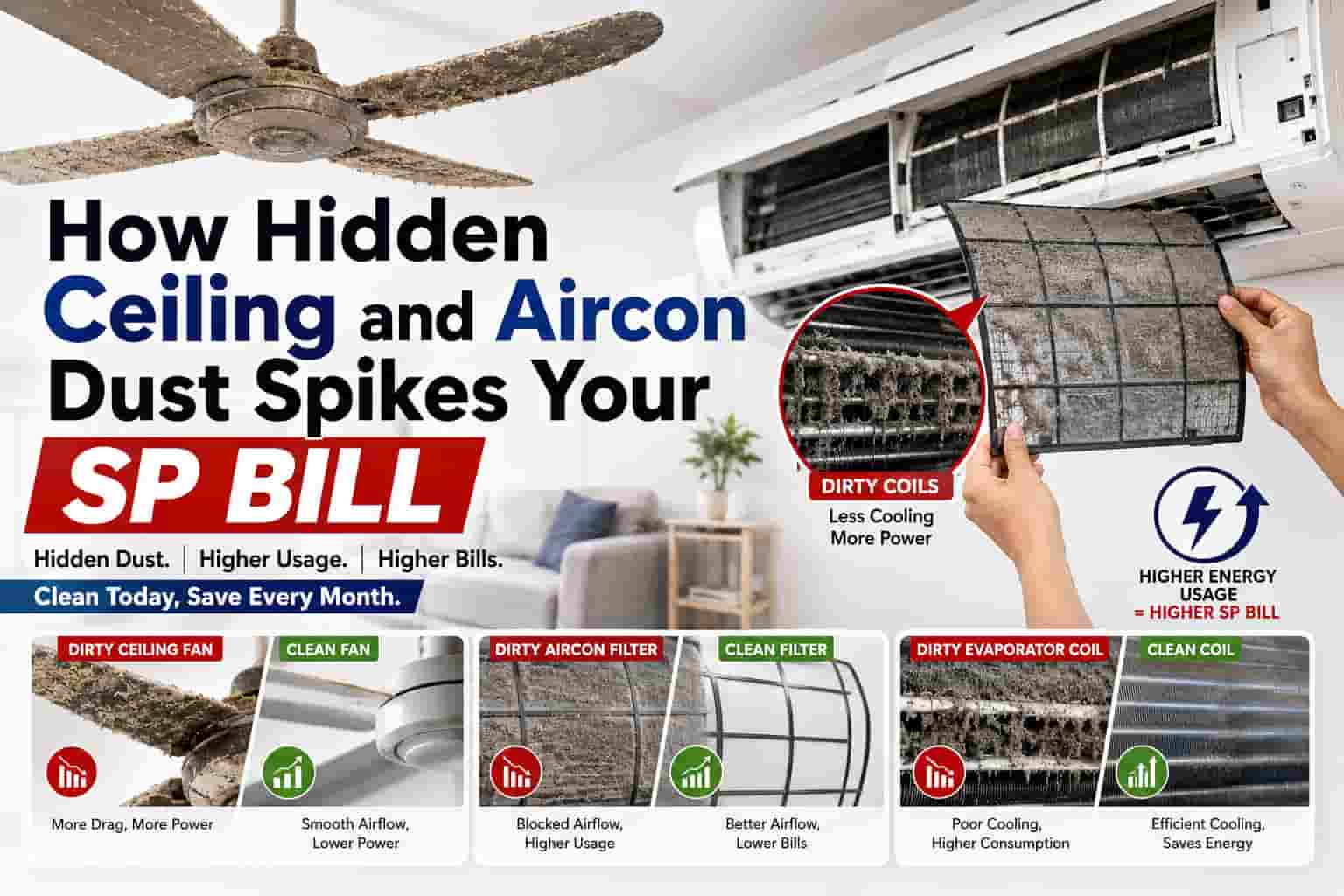
However, a fan blade that has not been cleaned in months undergoes an aerodynamic transformation. As the blade cuts through the air, static electricity turns the leading edge into a magnet for airborne grease and moisture particles. This sticky base layer captures every passing dust particle, building a thick, irregular, fibrous crust over time.
When a fan blade loses its smooth, aerodynamic edge, it can no longer slice through the air cleanly. Instead, the irregular crust creates massive air resistance and aerodynamic turbulence. The blade drags against the air rather than gliding through it smoothly. To maintain the speed setting you selected on your remote control, the fan’s electric motor has to work significantly harder to overcome this artificial drag. It draws a steadily increasing amount of wattage from your electrical mains, converting electrical energy into wasted heat within the motor housing rather than pure kinetic airflow. Over a year of continuous operational drag across multiple rooms, this minor, invisible power draw compounds into an unnecessary premium on your utility statement.
If your busy lifestyle leaves little room for managing intense high-altitude cleaning, outsourcing your household maintenance via structured part time cleaning arrangements is an excellent, flexible solution. Having a dedicated assistant focus on rotating tasks—such as targeting bedroom ceiling fans during one session and tackling kitchen exhaust vents during the next—keeps dust accumulation from reaching the critical mass that spikes your energy usage, ensuring your cooling systems run lean, clean, and completely optimized all year round.
Air-Conditioning Intake Blockages: The Internal Thermal Struggle
While a dusty ceiling fan adds a noticeable drag to your power line, a neglected air-conditioning system acts as an absolute sponge for your household budget. Air conditioners do not create cold air out of nothing; they extract heat from the interior room using chemical refrigerants, passing the air through a fine network of frozen metal fins known as the evaporator coil.
The primary line of defense for any air conditioner is the plastic mesh return-air filter. This filter captures larger airborne debris before it can blanket the delicate evaporator coils. In a typical home, these filters become entirely choked within a matter of weeks. When airflow is restricted by a grey wall of dust, the air conditioning unit suffers from thermal suffocation. The fan motor inside the indoor unit has to run at maximum velocity just to draw a fraction of the necessary air volume through the choked barrier.
Because the air cannot move freely across the freezing coils, the unit cannot cool the room efficiently. The temperature sensor signals to the compressor outside that the target room temperature has not been met, forcing the compressor—the single most power-hungry component in your entire home—to run indefinitely without cutting out.
For ongoing residential upkeep, relying on an experienced team like Singapore House Cleaning provides the equipment necessary to reach dangerous heights safely. Professional teams utilize specialized high-reach vacuum extensions, anti-static microfibre compounds, and safe mechanical steps to clean delicate motorized areas without risking structural damage to your expensive ceiling fixtures.
Aircon Vents and Evaporator Coils: The Insulation Nightmare
When dust manages to bypass a dirty or poorly fitted intake filter, it settles directly onto the damp surfaces of the internal aluminum cooling fins. This creates a highly destructive phenomenon known as microbial insulation. Dust is an excellent thermal insulator. When it coats the aluminum evaporator coils, it creates a physical barrier between the warm room air and the cold refrigerant moving through the pipes. The air conditioner’s ability to extract heat drops precipitously. You might set your thermostat to a cool 22°C, but because the dust insulation prevents efficient heat transfer, the system struggles continuously, blowing out weak, lukewarm air while drawing peak electrical currents.
In a clean coil environment, heat exchange happens rapidly, allowing the compressor to rest early. Conversely, a dusty insulation layer forces the compressor to run non-stop. Furthermore, Singapore’s extreme ambient humidity causes heavy condensation to form on these cooling coils. When this moisture mixes with accumulated internal dust, it forms a thick, damp paste that slides down into the internal drainage tray. This paste slowly clogs the narrow drainage pipe, resulting in the dreaded aircon condensation leak that stains walls, ruins flooring, and triggers a continuous cycle of poor efficiency. Worse, this damp, dark environment serves as an ideal breeding ground for toxic black mold spores, which are continuously blown into your indoor air supply whenever the unit is turned on.
Structural Cleaning vs. Surface Upkeep: Finding the Balance
Many well-meaning residents practice diligent daily floor care, assuming that a well-vacuumed room equals a clean home. However, gravity ensures that the finest, most lightweight particulate matter remains suspended in the air long enough to bypass low-level vacuums and settle exclusively into overhead fixtures. Daily and weekly routines typically cover wiping external touch panels, clearing immediate food spills, and emptying loose floor dirt. However, true professional deep cleaning must focus on internal mechanical de-dusting, the extraction of heavy grease, and the systematic eradication of stubborn mold spores lurking in high places.
To keep your utility expenses minimized and your cooling units functioning flawlessly, your household maintenance routine must transition from superficial sweeping to targeted, high-altitude sanitization. Wiping down walls, vacuuming the tops of wardrobes, descaling internal vent structures, and clearing high-level light fixtures must become structural priorities rather than occasional spring-cleaning thoughts.
Restoring the thermodynamic efficiency of your home’s upper fixtures requires a systematic approach to ensure you do not simply displace dust from the ceiling down onto your furniture. Never use a standard feather duster on a ceiling fan; it merely scatters the caked-on dust into the air, where it will eventually be sucked into your aircon vents. Instead, slide an old, damp pillowcase completely over a single fan blade. Press your hands firmly against both sides of the blade and pull the fabric outward. The friction strips the heavy leading-edge crust away, trapping all the grey residue safely inside the pillowcase rather than letting it rain down onto your living room floor.
Next, pop open the front cover of your indoor aircon unit and slide out the mesh screens. Take them to the bathroom sink and wash them from the clean side out using running water to easily dislodge the trapped dust blanket. Allow the filters to dry completely in a shaded area before reinstalling them. Running an air conditioner with damp filters creates an instant mildew problem. Finally, wipe down the directional swing louvers and the exterior casing of the vent using a microfibre cloth lightly dampened with a disinfectant solution to remove static buildup.
When to Call in Professional Maintenance Services
While basic filter washing and fan wiping fall within the realm of standard domestic upkeep, reversing months of deep internal mechanical fouling requires industrial tools, chemical solutions, and expert handling. If you are a tenant transitioning out of a property, ignoring these hidden overhead zones can lead to significant financial conflicts during final inspections. Property agents routinely shine flashlights into aircon louvers and run fingers across the tops of fan motors.
Booking a comprehensive post tenancy cleaning service ensures that these critical energy-draining zones are professionally detailed, protecting your security deposit while returning the property to the landlord in a compliant state. Professional teams can seamlessly access these difficult spaces, clearing accumulated buildup from sensitive motorized units without risking any structural harm to your components.
The Compounded Financial Return of Overhead Cleanliness
Maintaining a spotless home goes far beyond the aesthetic pleasure of a tidy living space; it is a direct investment in your property’s operational health and your monthly cash flow. Every millimeter of dust allowed to solidify on a moving blade or an internal cooling fin acts as a tax on your household budget. By proactively clearing away these invisible thermal blockages, you ease the mechanical strain on your electrical appliances, dramatically lower your monthly SP Services footprint, and breathe in cleaner, healthier indoor air. Take a look upward today—your wallet will thank you for it.
FAQ
Can dirty ceiling fans really increase electricity usage?
Yes. Thick dust buildup creates extra air resistance on the fan blades, forcing the motor to work harder to maintain the same speed. Over time, this increases electricity consumption and adds unnecessary strain on the motor.
How often should aircon filters be cleaned in Singapore?
In Singapore’s humid environment, aircon filters should generally be cleaned every two to four weeks depending on usage, pets, cooking habits, and dust levels. Dirty filters restrict airflow and force the system to consume more electricity.
Why does a dusty aircon make the room feel less cold?
Dust buildup blocks proper airflow and reduces heat transfer inside the air-conditioning system. As a result, the unit struggles to cool the room efficiently, causing the compressor to run longer while using more electricity.
Can professional cleaning help lower my SP bill?
Yes. Cleaning ceiling fans, aircon filters, evaporator coils, and ventilation areas helps appliances operate more efficiently. Reduced airflow restriction and lower mechanical strain can improve cooling performance and reduce energy consumption over time.
Useful Articles To Read
- 10 Weekly House Cleaning Realities Every Singapore Homeowner Should Know
- How To Choose The Right Cleaning Frequency For Your Home In Singapore
- Post Tenancy Cleaning Checklist: Pass Your Singapore Inspection
- What Buyers Notice First During Property Viewings in Singapore
- Move Out Cleaning Checklist for Tenants